Invisible Fingerprints
reflection on writing a difficult play


It is a really challenging thing, to write a play.
To create, it’s a challenge.
Trying to figure out how to make the colors work, flinching at a sentence because it’s uses the word ‘because’ twice, staring at the lines of a drawing, squinting at how your voice squawked when you sang that phrase, biting the inside of your cheek because your staging doesn’t look quite right, creating is a challenging thing.
And it’s the challenge that’s what makes it worthwhile.
But when we put our art forth, the struggle of the thing’s creation is rarely visible. Audiences see performances that have been rehearsed and staged, listeners hear music that has been practiced and recorded, readers read words that have been edited1 . And yes, even though every piece of art is a constant work-in-progress, the artists usually looking at it and seeing where and how they might have done something differently, by the time it gets to people, it is in some level of ‘done’ even if just for now.
We don’t often see the author squirming in their seat at the coffeeshop they forced themself to go to because their house was too distracting and stifling a thing, getting lost in thought as they bite their cuticles and pull at the dry skin on their chapped lips. We don’t see the sleepless nights, the wandering daydreams, the furrowed brows, the heavy hearts. And maybe that’s a good thing. Maybe we shouldn’t see any of the pain that created the art in its creases.
We lose sight of the challenge, both as the artist who has created the thing and as the consumer of art. Behind every piece we see is a story of its creation we’ll never hear. It’s easy to forget because the building of thing isn’t supposed to be a part of the story. What we see, hear, experience, that’s the story.
But I wanted to write about a play that was hard to write. Because it’s on my mind. And maybe it will be a helpful thing, to share the unspoken story of its creation.
We’re Okay, We’re Okay, We’re All Gonna Be Okay was a play that kicked my ass to write. It really tore me up from the inside out. Unfamiliar territory for me. Because yes, creating a play is always a challenging thing to do, but it hadn’t been hard in a long time.
I was ecstatic when I learned I’d be the recipient of The Farm Theater’s College Collaboration Commission. I couldn’t wait to get started. I had pitched the idea of looking at Hamlet through the lens of mental health. I knew I wanted it to be a small cast play, I knew I wanted to write a couple of roles for men – and that’s all I knew.
I spoke to students, getting their perspective on mental health and how it was affecting their generation/what they wanted to see represented in media/what they thought about Hamlet and Shakespeare – all really, really helpful. I spoke to Padraic Lillis, Artistic Director, about the play, about Hamlet, I asked my Instagram Stories what folks felt belonged in a piece that’s in conversation with Hamlet and got lots and lots of passionate responses. I gathered everything together and I went to write it and
I choked.
I couldn’t get a word out.
Usually my plays start to speak to me. Characters, snips of dialogue, ideas, I can doodle them out, follow a thread, find the energy and explore it.
Let me be so clear, nobody was putting pressure on me but myself. Padraic was very clear about the expectations of this commission, which was a first draft didn’t even have to be ‘complete’, it could have scenes that were outlined, and that there would be ample time to rewrite and re-shape and re-sculpt. But I wanted to get it Right.
An impossible thing to do, but a mountain I couldn’t move from my mind.
One that cast a large shadow, making it hard for me to see.
Finally, a jock appeared in my mind. And his name was Zeus. And he wanted to be in Hamlet.
I started to build out the play around him. I knew I wanted Zeus to have a roommate and that they would fall in love with one another. Because I was already playing with uncommon names, I gave his roommate the name Aster. I had no idea how Aster would fit into the play – but he was there!
The ghosts – I loved the ghosts! – so I’ll focus on the ghosts. What if there were two friends who were doing a séance, trying to communicate with the ghost of a friend who had passed?
I had to name the two friends. Finally, the tasks were becoming clearer. I named those characters after two of my best friends. Lana and Chris. Lana, a shortened version of one of my best friends’ first names, Chris, a shortened version of my best friend’s middle name. It helped me feel like they were with me, while I wrote the play.
The weight of mental health and portraying mental health and portraying suicide – it was heavy on my heart. Heavy, heavy, heavy. It scared me. It was a scary thing to do. But I needed it to be a part of the story. I knew I needed it to be.
I had about thirty pages of the play when I met with Padraic, one summer day about a month before the play was due. I held the struggle close to my chest and acted a lot more confident than I actually felt. Inside my smile, I was screaming.

A few weeks later, a prominent New York City artist died by suicide and I, like many artists, felt our worlds crash around us. A few days after that, my father was hospitalized for what would be a long time. An excruciating time. And my deadline was creeping ever closer.
How do you write a play when your world is cracking at the seams?
How do you touch the livewire and know you’ll be okay?
There were times I didn’t think I would be able to finish. But I wanted to. I wanted to figure out the play, I wanted to write it not just for me, but for the colleges. I forced myself in front of the page. Don’t you want to see what happens? That’s the question that helped me move the story forward. A small curiosity that rang true. Don’t I want to see what happens? The question that wrapped around my brain like a blanket during those sleepless nights, that sat at the back of my mind during walks. Don’t you want to see what happens every time I wrote a scene I cringed at, I deleted a monologue that didn’t work quite right. I wrote at coffeeshops with one of my dear friends, Dani Martineck, and I wrote in the digital space with dear friend Tristan Willis. And I finished a draft.
A messy draft.
A disgusting draft.
I hated that first draft. I’m probably not supposed to say that, but I did. All I could see was its flaws. But knew I needed to hear it out loud. I was relieved it was done, that there would be something to sculpt, but what to sculpt?
I tried to put together a virtual reading but got overwhelmed – my dad was still in the hospital and I knew I might need to fly down to Florida to see him and my mom at a moment’s notice and putting together a reading, even a casual virtual one, felt like an insurmountable task.
One of my good friends, Matt Barbot, offered to take the reins and did it for me. An incredible act of kindness. A generous act of kindness. He gathered some actors together, gathered our virtual space, and led the reading and talkback afterward. I felt so held, artistically. And as a human and a friend. My plan had been to just stare at the page and poke around at it, but hearing it out loud helped. Hearing how other people didn’t hate the play helped. Hearing it made me say to myself The play will never be like this again. I can make it stronger.
It’ll be okay.
I rewrote the draft, sent it to Padraic, but I still felt so insecure. I still kinda hated it. I wanted to apologize for it. I couldn’t see anything but the cracks, but the struggle, but the pain, the insecurity and confusion I had battled through to sculpt the thing.
Padraic wrote back and said he loved the draft.
That helped.
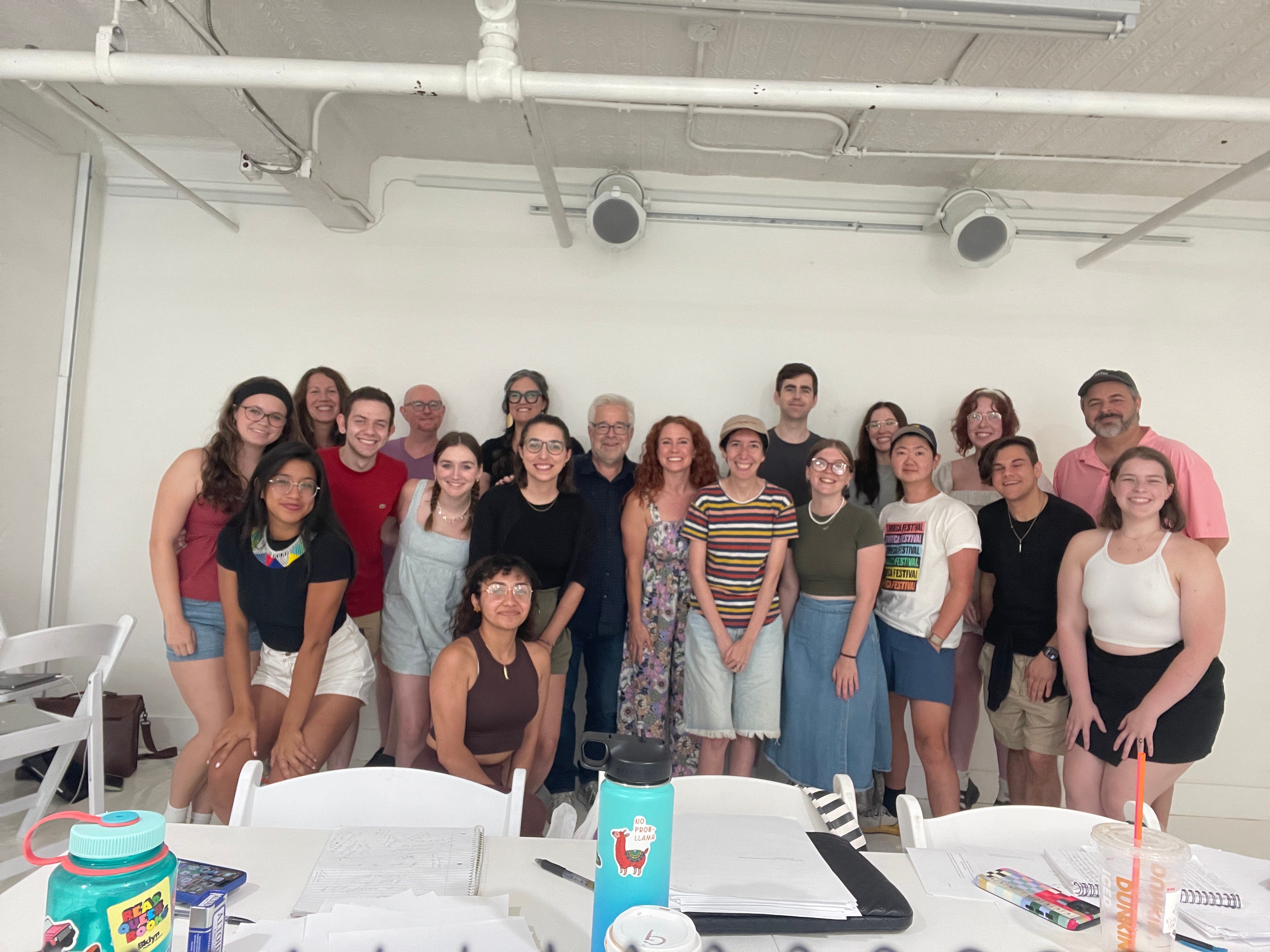
There was a three-day workshop for the piece scheduled for mid-August. Professional actors would read the roles and students and staff from Austin Peay University and RIT would be in the room, to offer their own thoughts and notes. I flew down to Florida the week before, finally able to see my father. He was out of the hospital and now in rehab. Finally able to see my mother, who I spoke to three times a day to get updates about my father’s health and to make sure she was okay. I came back to NYC on a Friday and we jumped into our workshop on Monday.
We read through the play and again, all I could hear were the cracks and pieces of pain that had accompanied me as I wrote it. I squirmed and flinched and furrowed my brow. I wanted to run out of that rehearsal room, down the stairs, out into the incredible hot and humid streets of the City, screaming at the top of my lungs. Surely that’s all everyone will see, too, the cracks and pieces of pain, the flaws and mess.
I didn’t run. I stayed. And I listened to what the students and actors had to say.
And I heard all the stuff in the play that they enjoyed. That resonated. They had great, astute questions and notes, but I also heard what was working. That there was something there. Despite the cracks I knew were there, all the sleepless nights and anxieties and worries, grief and pain that bled into the experience, there was something else there.
And the piece was and wasn’t about me anymore.
Something that happens in every process – our pieces come from us but they are not us.
During our two productions, the students in the play and in the audience told me how much the play meant to them. How much they saw themselves reflected in the piece. But those fingerprints are always going to be on this play for me. I’ll always see them, smudging certain monologues, lines. I’ll see the kindness from the friends who helped me write it, the notes that made the characters stronger. Nobody will see Dani, Tristan, Matt in those pages, but I will. I see my best friends. I see my father. So many fingerprints, completely invisible to everyone else but so glaring and clear to me. There’s a part of me that will always hold how hard it was to write the play, that creates a barrier between me and the piece. And I think that’s okay. Because I’ve learned how to love it in my own kinda way. And that’s okay.
It’s okay.
A few announcements before we go -
I am offering two virtual writing classes this spring!
Creative Jumpstart is a 5-week course for writers across genres, designed to get you out of your head and in touch with your heart and to start a new project. All information, including pricing and how to register, is available on my website.
Playwrights’ Workshop is a playwriting workshop for playwrights who are hoping to make significant progress on a new play, or on rewriting a play. Playwrights will be able to workshop up to 20 pages of their play every other week. All information, including pricing and how to register, is available on my website.
One-on-one dramaturgy is back for February! Do you have a new year’s resolution to rewrite a play? Do you want accountability for a play you’re trying to write? I’d love to be that outside set of eyes for you.
I wrote an essay for The Hat about creative resilience! The Hat is a great online magazine that focuses on all things theater, so I highly recommend checking them out.
MERCUTIO LOVES ROMEO LOVES JULIET LOVES and The Virtuous Fall of the Girls From Our Lady of Sorrows are available to be purchased and licensed from Original Works Production! Please consider licensing these plays as part of your upcoming theater season.
That’s all for me! Thank you for being a supporter of The Rejected Writer. I hope you enjoyed this bonus essay! I’ll see paid subscribers at the end of the month with a sneak peek at a new novel. But until then, please protect your art - and your heart.
Even if just by the author frantically looking through and hoping there aren’t too many glaring mistakes before they click publish.